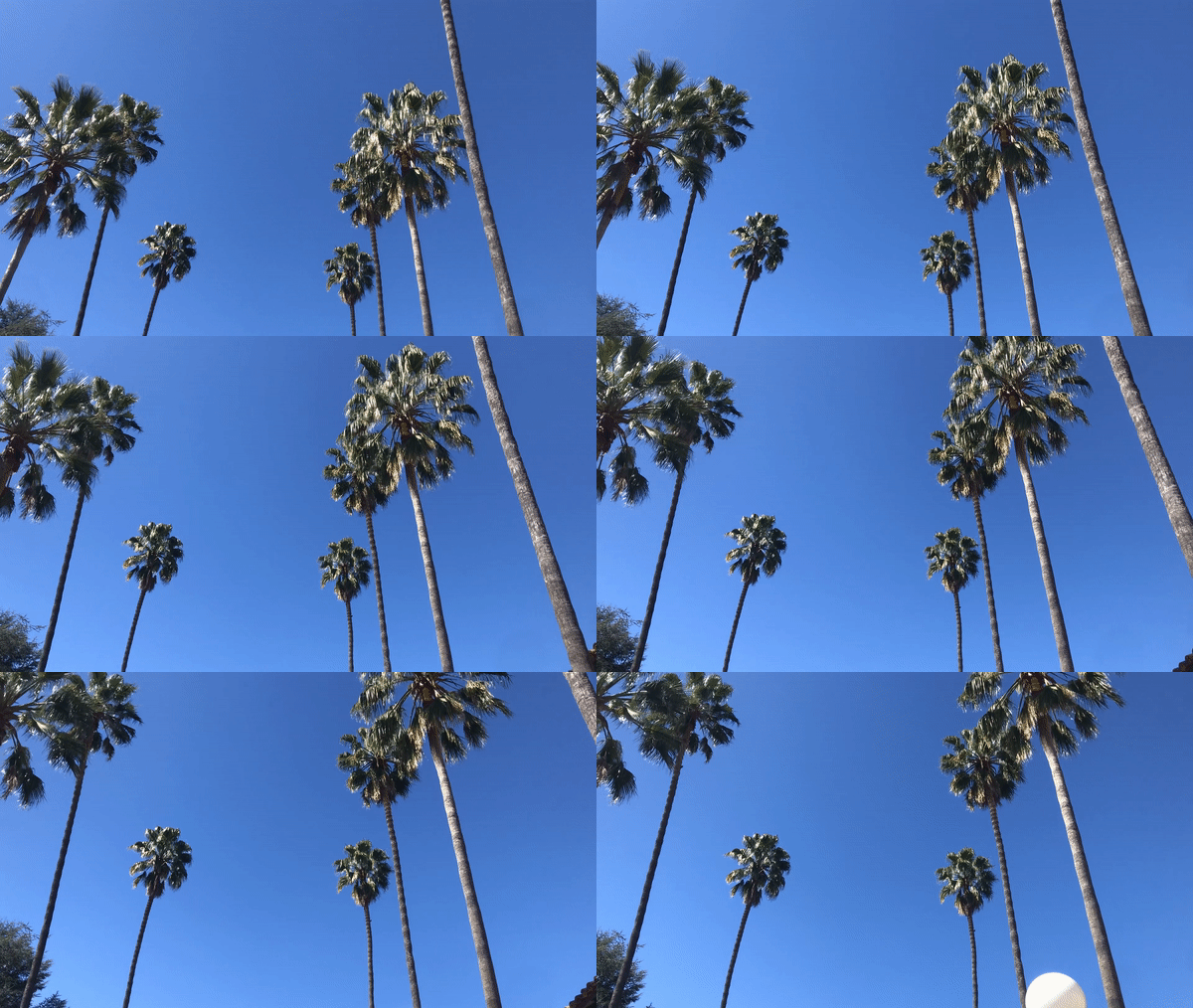
Saying Goodbye
15th March, 2019
Stanford, California
Privacy, freedom, being in love: this past year I’ve come to realise that they are, in some ways, the same thing. This place, Stanford, was my first real taste of it, them. It was my internal life magnified to encompass the world around me. Plastered against the walls, in my words, in how I chose to do what I did, every moment of the day.
It’s not like I wasn’t free before, that I didn’t have privacy, that I hadn’t been surrounded by love. None of these things are true, and yet. Maybe it was the right age to realise what they really meant, maybe it was the right place in my life to see their value and to choose them.
I think before, I saw privacy as a negative space, as an absence of control or of others, of the obligations they bring. Any desire for it, and there was plenty of that, came with the immediate sense of guilt: it felt like not appreciating the people in my life, like shrinking from responsibility and the hard work of living and loving other people. Privacy felt like stealing time — time which seemed always to be running out, time which belonged not to me but to everyone else. I think of a room with a view — and I think of countless knocks on the door and interruptions asking you to come outside, to join the world. To live outside your head.
Here, I found something different. I found a sense of privacy that wasn’t deprivation, wasn’t guilty, wasn’t absent in caring. I have walked all over this campus: all four years, everywhere I lived. It began, and to be honest persisted, largely due to my inability to bike. But I’ve come to love all the hours I’ve spent cutting across lawns and wearing out my platform shoes: in these hours I’ve been alone, I think more so than anything, I’ve found a freedom to be with myself that life rarely affords. It was these moments of quiet, that I could be without having to think too much about being — where I was freed up to see the world with a little more clarity because I did not have to worry about being looked at, being seen.
I call this privacy and I call it freedom because it is within the same last inch where you are most yourself and most free — where there is no right and wrong, there is no need for walking on your knees. And I call it love because — and this I will never be able to explain — it is the sense that this moment, the one you’re living, is not the means to any end, that this is alpha and omega — this moment, it is grace. The work of becoming yourself starts here, with the foothold of being with yourself, by being yourself, entirely. The work of love begins here too: in the space of privacy, of holding an idea rather than deciding it, of reaching towards but not yet finding. You have to be able to imagine people to love them, if that makes sense. You cannot do that without an internal space to look out from.
In a week, I’m leaving Stanford. In some ways it feels like leaving the space of freedom, privacy and who I became here as well. I know that’s not entirely true, that we carry our loves, our lives and all our days inside us wherever we go. And yet it in a way it is true, because five, ten, fifty years from now we will be different people. I know that that is good, it is exciting, it is life — but it is also a loss. We[1] will always remember, and yet remembering is both an act of finding and of losing: because in remembering you become more aware of the otherness of the past, even if it your own.
That’s why I needed to write this, this sprawling and clumsy attestation to what is was like to be here, to be me, but also maybe in part, to be you. We are all leaving. In trying to say what it is that we had, what it is that we’re losing, and what we’re not, I hope I will understand how to say goodbye. Because I don’t, not really. And I cannot leave without saying goodbye, because of everything this place is, because of everything you all have come to mean to me. Privacy, freedom, love: the best thing this place has given me in being able to find myself is the ability to see all of you, to fall in love with all of you.
Should I start with what I learnt from here, from you? I have so much advise and nobody to give it to! Always take the longer path if you can, always look up if you can. Try to stay with friends for a moment longer. When your friend is telling you about heartbreak, family, life and they say abruptly, “Anyway, how are you?” Ignore them to ask about what they just said. Remember, “Attention is faith’s form. It grants that there might be something worthy there.” We are each other’s keepers, for however long we are here. What we ask of each other, what we find there, what we are to another — that is our lives work.
Be patient with yourself, and try also to be kind. Let’s make something happen to this world — that is the common refrain. I think first let us try to be in it. Feel like it is ours — without a need for a justification, without feeling that we need to vye for a reason to explain why we ever came here. To feel like perhaps it is fine to live in the world, and that is the way in which we will change it. I really do think you have to love the world, even now, even when it’s not perfect or even fine. I think of Fred Moten: “I believe in the world and want to be in it. I want to be in it all the way to the end of it because I believe in another world and I want to be in that."
I think of that quote often, when I think of the world and how it should change, but also when I think of myself and how I need to change. It has to start from love — because in the end, you’ll end up becoming yourself. But along the way, it has to start with being fine, with taking care of who you are today. Not tomorrow, not five years from now — I think of Anna Deavere Smith (I think in quotes), “What you are will show, ultimately. Start now, every day, becoming, in your actions, your regular actions, what you would like to become in the bigger scheme of things.”
In these four years, I’ve tried to remember that as I chose what to do in a day. In choosing to take another class or to sit at lunch even after everyone has cleared their plates. In deciding what to say, in how long to stay up, in getting another hour of sleep. Because these days, all these days accumulate in you so that every corner holds a memory, every story feeds into another. Do you remember walking around the quad that one time? Late at night when we were freezing? Not in the winter — but before that, freshman year, when we would decide on a whim to do things like that. Do you remember that autumn day doing work on the turf? Do you remember? Partners, friends (new, old), parents — they will listen to these stories and nod politely and ask clarifying questions. But how can we ever explain what it felt like to be here, now and to be alive? To be young. They will never know, the way we know, the days that made us.
Some part of you will always be walking through that door for the first time. Some part of you will always be 21 and trying to match your roommate shot for shot, some part of you will always be experiencing the first serious failure of your life. Even as we forget, we will remember. Remember seeing MemChu, the inside, the gold — for the first time? Remember the waffle fries and guac at late night? Remember feeling your heart break so far away from home for the first time?
The moments here have the quality, even while being lived, of becoming memories. I have moments sometimes, walking home or in the middle of laughing at something, right after leaving a friends dorm — where I know that I am inside a memory. I know I will look back at this moment in time and I know I will remember fondly. I know that this moment will glow with the realisation that my heart felt so heavy because it could not contain the simple happiness of this freedom, of this joy, or this opposite of loneliness, of this love.
It’s okay, it’s okay, it’s okay. I keep telling myself this even as I refuse to believe it. I keep telling myself this until I see you, over dinner, in class, for a study session. And then it really is okay, because how can I ever lose you, who I love? Who I know and yet discover everyday? And then I tell you, when you say you’re sad to not be — you’re always going to be in my life. It wouldn’t be my life if you weren’t in it! It’s okay.
I fell in love here, over and over again: I found my people, my ideas, my voice, my silence here. I found a love deeper and stronger for those I left across the ocean, and the contours of their absence made their presence all the more urgent when found.
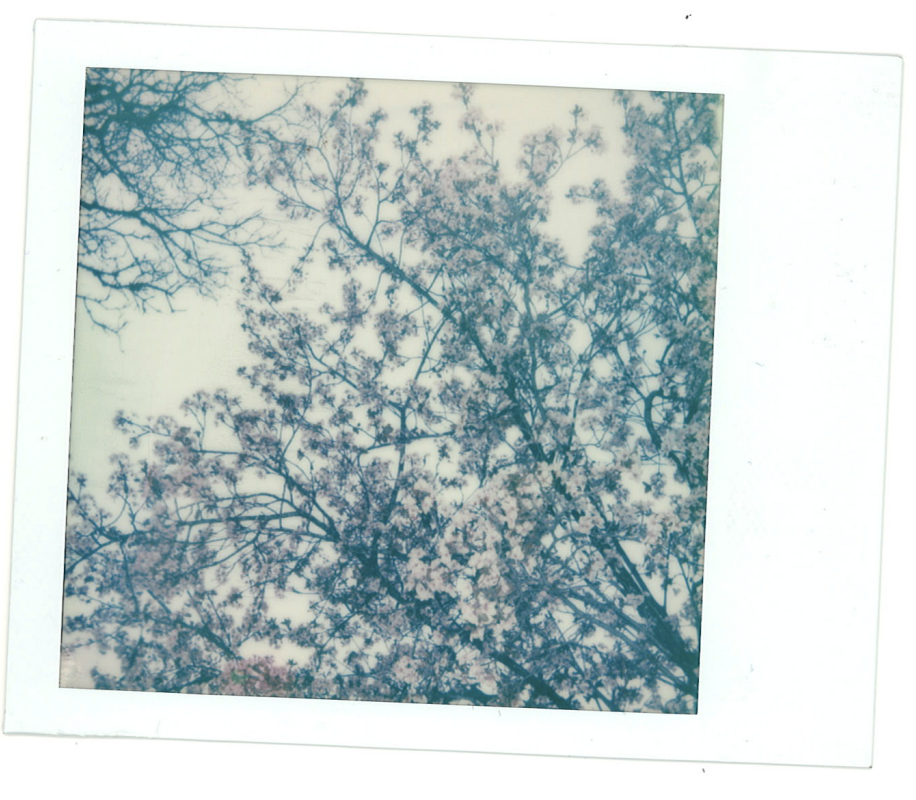
I fell in love with the tiny birds that still terrify me, with the wanton blooming of the magnolia trees around every corner. I fell in love with the long walks with friends who run into you on the way to class and I fell in love with the people you see once a quarter but never let go of.
I fell in love with feeling the sun on my face. With the wind as it moves through the vines on the law terrace, with the fountain that whispers as countless walk by. With the surprisingly reality of other people. I fell for a sky so blue you could lose your mind. The abundance of it. How do you keep yourself from stopping, from being knocked over?
I am struck by how lucky I am, constantly. I know I shouldn’t jinx it, I should be more humble, but there is too much in life that is hard to be ignorant of your blessings. Even after all these words, I could never tell you how much these years have meant to me, how much you’ve meant to me.
Thank you for four years, and thank you for the eternity within them. Thank you for giving me myself, for giving me the world and the people who make up my corner in it.
Of course, every place has its magic. I’m in the Law School terrace so it feels a little more concentrated towards me, but I know that to every person their place will always be the most special. But it doesn’t matter if I’m delusional, if anything, it proves the point.
I could’ve gone anywhere, I could’ve come here at any time, I could’ve lived anywhere, met anyone — a million things could’ve changed absolutely everything. So what? I could live a million lives, write a thousand versions of this and none of them would be the same because I wouldn’t be the same. These are the particular ways in which I cried and laughed and learnt and loved — and that it happened despite the fragility of chance makes it all the more valuable.
There are as many loves as there are hearts.
This place taught me how much love my heart can hold: in the days I was here and falling in love, with every moment, person and gust of wind; but also when I was away, when I was missing those who made my heart feel like it didn’t exist solely in my body.
I’m told I fall in love too much: everyone can tell when I’ve made a new friend because I cannot stop gushing. I’m told that every book cannot be the most phenomenal, that you cannot have five best friends, no concessions for different lives lived in these two decades. If you can’t pick, say you can’t — don’t pretend, don’t exaggerate, don’t oversimplify. Don’t say it to just say it.
But here’s the fact of it: I’m the one writing this, and this is how I feel. The honest truth, even through the burnout and the stress and the schedules from hell and the rain and caterpillars hanging from every tree: it’s been four years, and the feeling hasn’t dimmed. For this place, for these people. I must say this because I must ask: how will I ever get over you, all of you?
How do I show you the days you’ve given me to carry forever: the conversations stalled by laughter that keeps you from delivering the punch line, the essays we pretended we were writing. How do I thank all those people I only got a moment with — that one time at TAP, that one song in the car, that one conversation? How do I thank those that became my everyday, whose day I knew like mine. I walk past the PRL and have a memory — but it’s not my day I’m remembering, but yours. When I make it to the Dish for the first time, at the end of four years, I find it littered already with stories — again, not mine. When I see you in the blue light of a party we went to on a whim and you stick your tongue out — I see all our weekends, all four years of them, and I wonder, how can I ever leave you, leave this?
Of course, we will never really forget, we will never lose in entirety. How can I — we remade each other in countless little ways over these years. We carry each other in the way we tell jokes, in our stories of growing up, in our heartache and the words we use to get through it. Remembering is tough, but it is a problem I feel lucky to have. I tell myself, it hurts as much as it was worth.
I like to think that this sadness is like those moments where skin is colored when a bruise is formed — marking what was before unblemished but also unnoticed. These are the moments when living takes on the slant of experience.
Three things to consider:
1. “In life, remembering (missing, truly wanting what we desire and living with it) is the problem.”
2. I read Kathryn Schulz’s piece on loss while sitting outside class once, waiting for the session right before it to end so I could enter. I ended up skipping the class entirely to hide in the stairwell and finished it. It is the kind of writing one would learn by heart and recite into existence again if the apocalypse ever came and took the New Yorker website down. She writes,
“There’s precious little solace for this, and zero redress; we will lose everything we love in the end. But why should that matter so much? By definition, we do not live in the end: we live all along the way. The smitten lovers who marvel every day at the miracle of having met each other are right; it is finding that is astonishing. You meet a stranger passing through your town and know within days you will marry her. You lose your job at fifty-five and shock yourself by finding a new calling ten years later. You have a thought and find the words. You face a crisis and find your courage.
….We are here to keep watch, not to keep.”
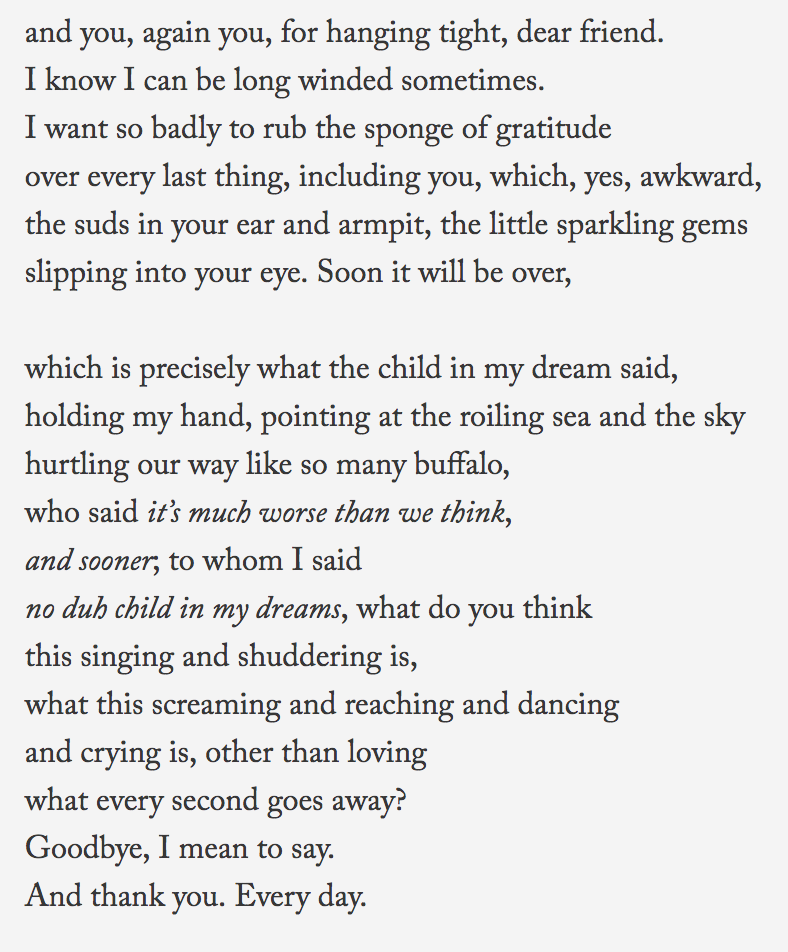
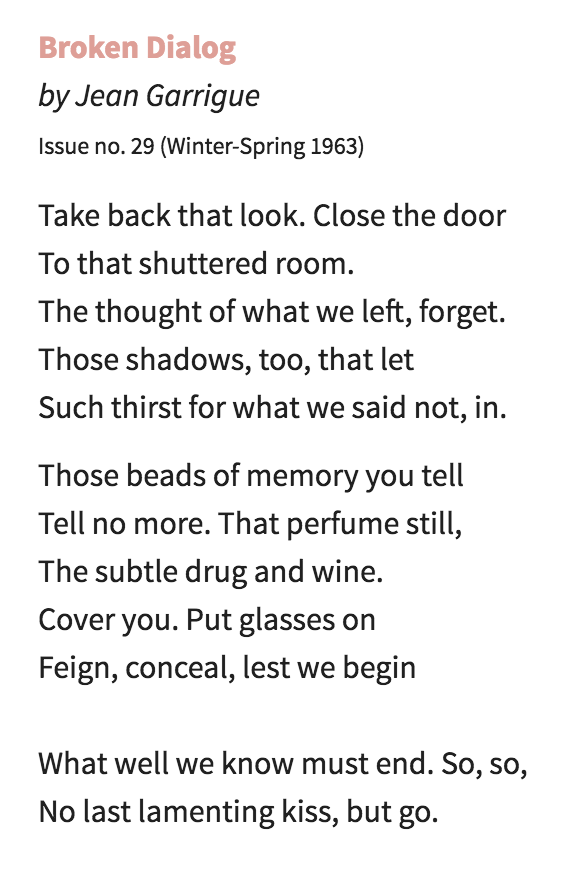
3. This poem, which I got from the Paris Review in my inbox, on my last day of classes:
I wrote this because I need to say goodbye, and yet I’ve spent 3000 odd words saying everything but that. I hate saying goodbye because that’s not what I want to say. I hate saying more than a goodbye because nothing, not this, not any number of words or tears can ever tell you how much my world is changed by having you in it. How do I look you in the eye without telling you everything, without taking up another four, five, ten years, in just recounting everything you’ve done for me? I’m not sad — and I am excited for the future, I really am. Consolation is not the point.
It makes me impatient to even imagine saying goodbye, because my greatest frustration is the limitation of words. I miss you because I found you, because I was fortunate once to have found you.[2]
I know this. I want you to know that I do know this, that if I cry[3] it is not because I am sad but because I am so fortunate, because there is no other way I know to show you what I feel.
I don’t know how to say goodbye, I never have. I usually duck out the morning of my flight, I tell people the wrong date that I’m leaving, I tell people I’ll come by before I leave and then there’s never enough time. Because there’s nothing to say at a goodbye. There’s just moments when you’re waiting for the uber to pull up, or someone is putting the last few things away, and this moment is imbued with a strange kind of sadness because it is about its own end. It’s too early and it’s too late, it feels like.
I haven’t started missing you yet, because here you are, in front of me. But it’s too late to move on, to protect myself by pretending it never happened, because here you are, next to me.
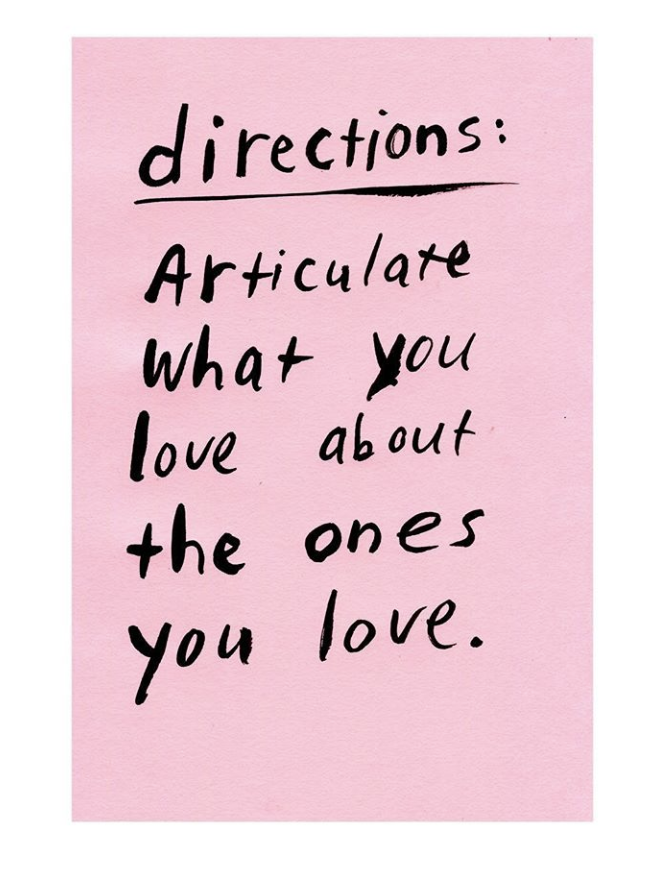
I love you, you know this. What else is there to say?
[1] When I say we, I mean I. I also mean you — because I am asking.
[2] “We shall not cease from exploration,
and the end of all our exploring
will be to arrive where we started
and know the place for the first time.” — T.S Elliot
[3] I like this poem, where being reflected in a tear is the last way in which two people are together before saying goodbye. It is sad, but it is sweet too: by showing you my sadness, we come together one last time. I have failed in doing this before and come to regret it, so I’m trying harder this time.